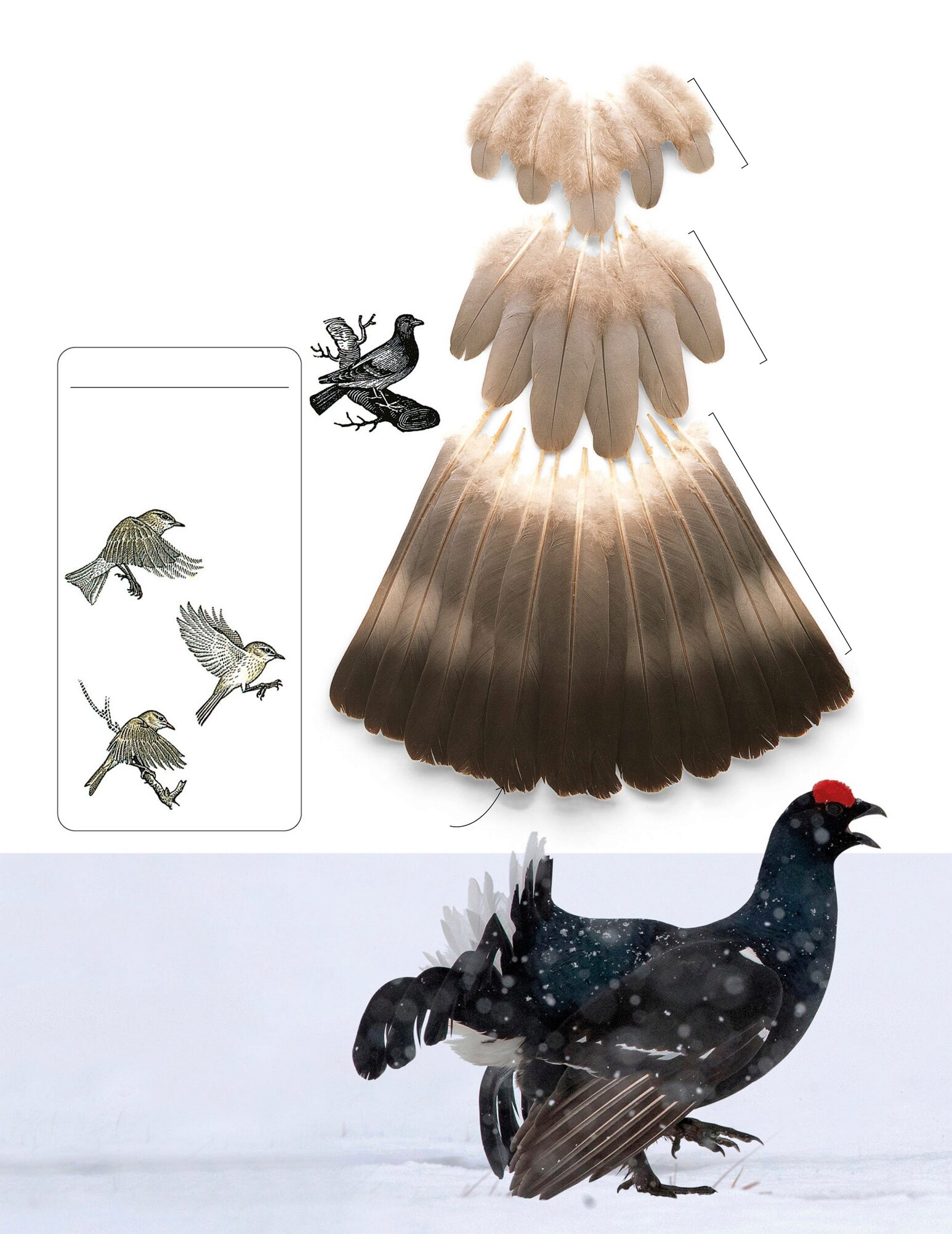
Rump feathers
The rump feathers
above the base of a
wood pigeon’s tail
provide insulation.
Tail coverts
Dense rows of these
feathers smooth
the air flow over
the tail.
Tail feathers
Like most birds,
the wood pigeon
has 12 tail
feathers.
Wood
pigeon
Tails
Some birds, such as guillemots and
puffins, have hardly any tail, while others,
such as peacocks and male birds of
paradise, have long, trailing tails that
make flight difficult.
Tips worn and frayed
by flight and rubbing
against the ground
When a bird comes in to land,
it lowers and fans out its tail
feathers. The feathers act as a
brake, slowing the bird’s approach.
1. Tail fanned on
approach; body
held horizontally
2. Landing;
feet forward
to grasp perch
3. Tail closed
as bird settles
on perch
AIR BRAKE
Face-off
Two male black grouse
face each other in a
battle to attract
females. They spread
their tails, call loudly,
and leap in the air.